The prop firm casino: FundingPips, terminations, and what actually works
#trading . #prop-firms . #fundingpips
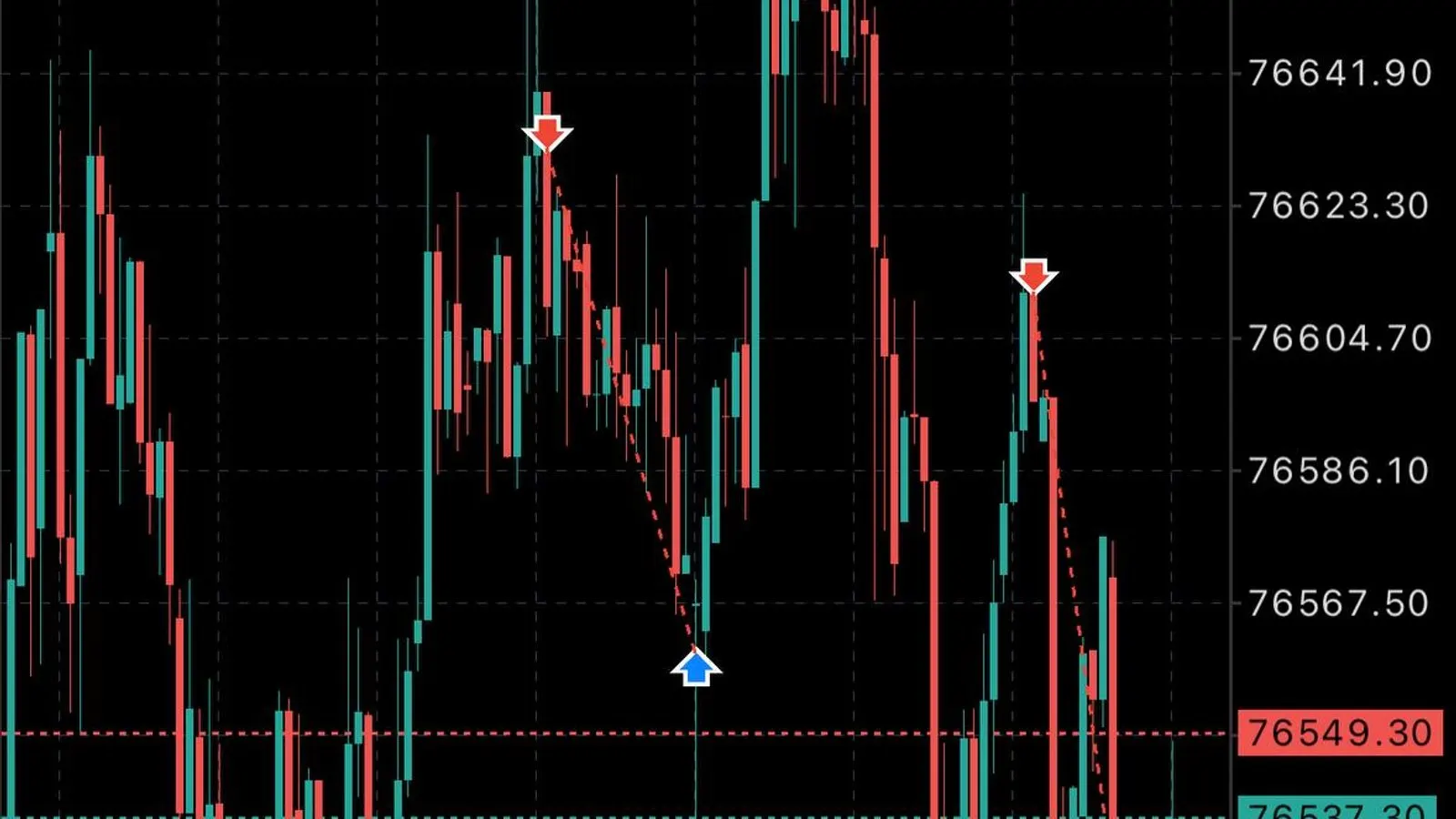
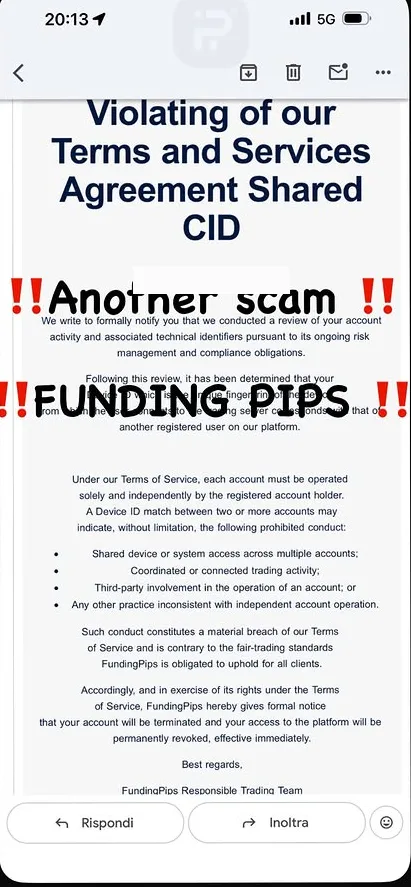
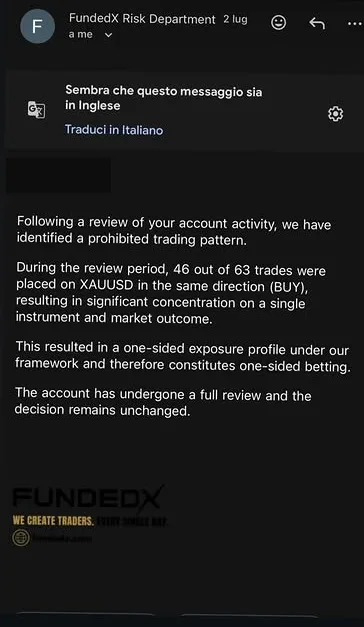
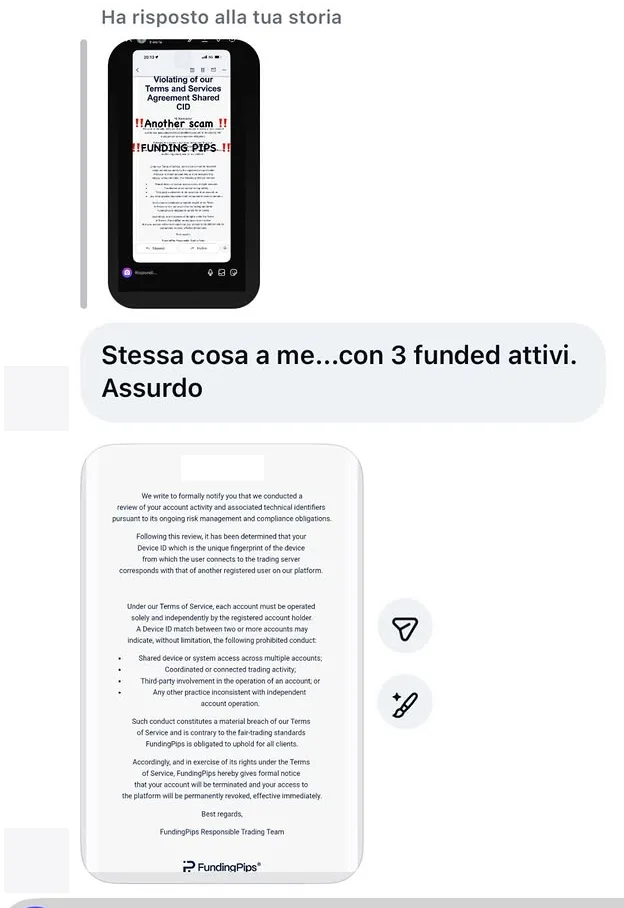
Right now my Instagram is full of the same screenshot. A funded trader opens their account and finds an email instead of a balance. FundingPips: “Violation of our Terms of Service, Shared CID.” Your device fingerprint matched another user, account terminated, access revoked, effective immediately. FundedX sends a different flavour: “one-sided betting,” 46 of 63 trades on gold in the same direction, therefore terminated. Different firm, same outcome. The account is gone and so is the money behind it.
I am not collecting these to build a case. Friends kept posting them, and once you have seen ten identical emails you stop calling it a coincidence and start calling it what it is. In my opinion this is a scam, plain and simple. And if one of these firms took your money, here is the part I want you to read first: you can probably get it back. I will show you how below.
I gamed them first, so let me be fair
Back in 2023 FundingPips terminated me too, and I will be honest about why. I was running a stack of five-thousand-dollar accounts and one-shotting them, big single swings, because the math is simple: buy fifteen challenges, you only need one or two to hit and you are in profit. I was treating their model like a lottery I had an edge on. They blocked it. That part was fair. I was exploiting the product and they closed the hole.
What came after is the part I have a problem with.
The rules are the business model
To stop people doing what I did, they did not just patch the exploit. They buried everyone under rules. One percent risk per trade. Forced changes of asset. Consistency requirements. Restrictions that have nothing to do with whether you can actually trade, and everything to do with making the challenge harder to pass. A good trader now fails on the rules, not on the market.
And that is the whole trick, because a prop firm is a casino. The house sets the math, and the house has to win. When most of the revenue is challenge fees from people who fail, “fair to good traders” and “profitable for us” pull in opposite directions. So when the payouts start biting and the company starts losing money, the rules tighten and the terminations begin. Shared device ID. One-sided exposure. There is always a clause. Even a trader who did everything right can be told, after the fact, that they did it wrong.
Call it what you want. To me it is a scam with a compliance department: a business that sells you a dream, changes the rules the moment the dream starts paying out, and deletes the account before it has to send the wire. The wave of FundingPips terminations people are posting right now is not a run of bad luck. It is the model doing exactly what it is built to do.
You can get your money back, and most people never try
This is the part I want every scammed trader to read, so here it is in plain terms. If you bought your challenges with Revolut, or any bank with real chargeback protection, you can dispute the charges and claw back everything you spent on them. People are winning these right now, getting every euro of challenge fees returned.
It works as a “service not as described” dispute: you paid for a fair funded account, they terminated you on a technicality and kept your money, and that is exactly the ground the dispute stands on. It is not a magic button, the bank reviews each case and leaning too hard on an account has its own risk, but it works, and almost nobody even opens the claim. If a prop firm scammed you, do not just post the screenshot. Check what you paid with, and open the dispute.
The way out is to stop renting a rigged game
Here is what I actually do instead, and why I think it is the only real answer.
If you have a strategy and you half know how to trade, you can script it into a bot. I build mine on cTrader through its API, not a MetaTrader EA, because MetaTrader is too clunky and slow for this, running on a small server connected straight to the broker. With Claude you describe the logic, check it, and iterate in a few sessions instead of a few months. Then you backtest it over five or ten years of real data. The backtest tells you the truth: this strategy is strong on these assets and worthless on those, so the bot only ever trades the ones that actually work.
That backtest is the only honest proof you can trade. A live trader runs on feeling, I think this one is good, let me size up. If it wins, he decides his strategy is real, when often it was just noise. The math underneath is merciless: you can lose twenty in a row and then win twenty in a row, and the edge is real the whole time. But a human who has just lost twenty in a row loses hope and quits, right before the turn. The bot does not lose hope. It is static. It does not feel the streak. It keeps executing the thing the data already proved.
So you put it on a live account, your own capital, and it runs. No one percent rule someone else invented. No forced asset rotation. No risk department deciding, after your best month, that your device ID looks suspicious. It is your money, your strategy, your machine.
The prop firm needs you to lose. That is where its money comes from. A bot on your own account is the first setup I have traded where nobody on the other side is rooting against me. That is the whole thing: own the game, do not rent it.
None of this is financial advice, and trading your own capital can lose it too. But at least the math is yours, and nobody can email you to say the game is over. If you want the groundwork, here is what a prop firm really is from the inside, and how I run everything with AI.
Scammed by a prop firm? Send me the proof
I am collecting these. If a prop firm terminated your funded account on a technicality, send me the screenshots, the emails, the amount you were owed. Message me on Instagram. Once there is enough evidence in one place, I will publish a full breakdown, firm by firm, with the patterns and the numbers. The more receipts land, the harder it is for anyone to call it a coincidence.
Send me your proof on Instagram →